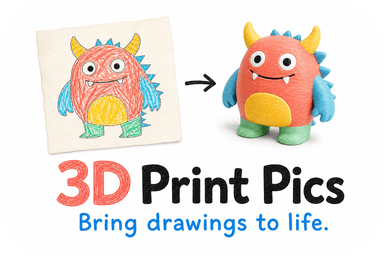
If your gift starts with a picture, such as a child's drawing, a pet photo or a logo, and you want people to hold the result, 3D printing is the better fit. Engraving marks the surface of an object that already exists. 3D printing builds a new object from your image, so the shape itself carries the memory. We make 3D prints from uploaded artwork, so that is where we land. Below we explain how each process works and which gifts suit which. We also show what it takes to order a print you can approve before it ships.
TL;DR
- Engraving removes a thin layer from a surface to leave a mark. 3D printing adds material layer by layer to build a whole object.
- Engraving suits text, dates and simple line art on a blank item such as a board, frame or glass. 3D printing suits a shape, such as a drawing standing up, a pet figure, a mascot or a miniature.
- A drawing, pet or logo is a shape, not a line of text. That is why a printed model usually feels more personal.
- Our custom 3D models cost $49.99–$77.99, are made from your uploaded image, and come with a preview you approve before the order is finalized.
Table of Contents
- What each process actually does
- Side by side: what you get
- Which one fits your gift?
- Speed, effort and what you actually do
- What it costs
- Can you combine both?
- Perspective
- Ready to turn the image into an object
- FAQ
- Sources
What each process actually does
The two methods work in opposite directions.
Laser engraving is subtractive. A focused laser beam burns or vaporizes the top of a material to leave a permanent mark, so a thin layer is taken away rather than added. Redsail Laser's 2026 comparison describes engraving as using a high-power laser to vaporize or remove surface material.
3D printing is additive. The same comparison describes it as building an object from a digital file by extruding, sintering or curing plastic, resin or metal powder. The printers behind keepsakes usually melt a plastic filament and lay it down in thin layers until the object is complete. Creality Falcon's August 2025 comparison puts it as slicing a design into layers and depositing material until the object is finished.
So the question is not which method is better in general. It is whether your gift is a mark on something or a thing in itself.

Engraving versus etching
You will see both words on gift listings. Engraving vaporizes material to cut a groove. Etching melts the surface and leaves a shallower mark. Xometry's guide gives engraving cuts up to about 0.020 inches deep and etching marks of roughly 0.0001 inch. It says engraved marks last longer because they cut deeper. Either way, you are choosing a mark on a blank, not a new form.
Side by side: what you get
| What matters | Engraving | 3D printing |
|---|---|---|
| What it does | Removes a thin surface layer to leave a mark | Builds a full object layer by layer |
| Best at | Names, dates, short messages, line art, monograms | Shapes, figures, relief images, mascots, miniatures |
| Needs a blank first | Yes: a board, frame, glass, leather piece or similar | No: the print is the gift |
| Color | Usually the color of the burn or the material | Chosen filament colors (we offer up to 7) |
| Depth and form | Flat or lightly recessed | Fully three-dimensional |
| Typical sources of the design | Text, simple graphics, photos converted to tones | Drawings, photos, logos and characters turned into a model |
Detail: both are fine for gifts
In lab terms, engraving can reach finer detail. Creality Falcon cites a spot as small as 0.03 mm with an infrared laser, against roughly 0.1–0.2 mm layer resolution for 3D printing. Redsail Laser gives typical FDM layer heights of 50–100 microns. Those numbers matter for serial numbers and tiny text. They matter much less for a drawing's character, which is judged by its shape and color, not by micron-level text.
Materials
Engraving suits a wide range of surfaces: wood, acrylic, glass, leather, coated metals, stone and paper. Bare metals and clear acrylic usually need a marking compound, according to Redsail Laser. Printing for keepsakes works with plastics such as PLA. We use non-toxic PLA, and we explain why it suits gifts in our guide to the best filament for gifts. If you are weighing PLA against resin, our PLA vs resin comparison covers it.
Which one fits your gift?
Here the choice gets practical. Match the gift to what you are trying to preserve.
A child's drawing
A drawing is its own design. Its wobbly lines, odd proportions and chosen colors are what parents want to keep. Engraving that drawing onto a wooden plaque turns it into a single-tone mark, so the colors the child chose are gone. A 3D print takes the outline and color choices and stands them up as an object you can put on a shelf.

With us, you upload the drawing, pick colors and see a 3D preview before finalizing. You approve the look first. For kids' rooms and classrooms, durability and safety matter, so read what makes 3D prints for kids last and what to check before you buy safe prints for kids.
A pet memorial
A pet memorial is about likeness and presence. An engraved photo on a plaque is a picture on a surface. A printed model of your pet gives a figure with volume. Many owners choose the model for the shelf and keep a text engraving, if they want one, for a separate frame or stone. You can send a favorite photo, choose colors close to the coat and review the preview before anything is made.
A business mascot or logo
A logo engraved on a pen or mug is a mark. A printed mascot is an object people pick up and keep on a desk. That is the difference between a branded item and a talking point. Our blog covers a full approach to previewed 3D holiday gifts for corporate teams, starting with a small pilot of 10–20 units. If you also need flat printed pieces to go with a mascot, such as cards and signage, print collateral for small businesses covers that side of a brand.
A tabletop miniature
Miniatures are shapes, so this one is not close. Engraving cannot make a figure. Printing is what miniatures are made with, and a character illustration can become a model you can paint or display in the color you pick.
A school project model
Students and teachers often need a physical version of a design: a landmark, a mascot, a cell, a character for a class display. A print turns a sketch into something to hold and present. An engraved board can label it, but the model carries the idea. Teachers, PTAs and homeschool families can use the same upload-and-preview flow, and our quick 3D signs from photos are a good example of a classroom or club project made from an image.
A gift for a specific occasion
For a birthday, a wedding, a retirement or a holiday, ask what the giver wants the recipient to feel. If the answer is "remembered by name and date," engraving on a blank is a sound choice. If it is "here is the thing you love, made real," print it. Gifts that benefit from 3D printing are also the ones where material and finish choices show: see how custom gaming desk artwork examples show a design carried into a finished object.
Speed, effort and what you actually do
Engraving is quick once a machine is set up. Redsail Laser notes a small nameplate can be engraved in seconds to minutes, while a phone-case-sized print may take 2–6 hours. For a one-off gift, those hours are not your hours. The work on your side is the same in both cases: supply the image and decide.
Ordering a print from us takes a few steps:
- Upload the image. A drawing, pet photo, logo or character illustration works. Clear, well-lit images with strong outlines give the model more to work from.
- Pick colors and size. We offer up to 7 color choices in non-toxic PLA, plus customizable size.
- Review the 3D preview. Our AI generates a model preview from your image so you see the shape before you commit.
- Approve and order. The order is finalized after your approval, and the print is delivered to your door.
- Add rush if the date is close. Rush processing is $10 on top of the order. It is listed as a separate fee on our site.
The preview step is what separates a keepsake from a gamble. You see the result before anything is made.
What it costs
Our custom 3D models are priced at $49.99–$77.99 per order, as published on our site, and rush processing is $10. For the wider picture of what small buyers pay for custom prints, see what small buyers pay for custom 3D prints.
Engraved gifts are a different kind of purchase, a mark on a blank, so the prices are not like for like. What you are paying for is different. An engraved plaque costs for the blank plus the marking. A printed model costs for the design work, the preview and the object itself.
Can you combine both?
Yes, and makers do. Redsail Laser describes a hybrid workflow: print a custom object, then engrave a monogram or logo onto it. For a gift, that can mean a printed figure standing beside an engraved plaque with the name and date. Start with the shape, because that is the part that carries the personality. Add text afterward if the occasion calls for it.
Perspective
Most people who come to us start with a picture they cannot bear to put in a drawer: a first drawing, a dog who is gone, a logo that began as a napkin sketch. A mark on a blank board keeps the picture flat, and flat is how the picture has been kept all along.
What we built is meant for the other thing people want: to hold the image. You upload it, choose your colors, and see the 3D preview before you finalize. We print it in non-toxic PLA, and it arrives at your door as an object with weight and shape.
When a gift is about a name and a date, text on a surface does the job. When a gift is about a character, a face or a design, the shape is the gift, and that is why we put our effort there.
Ian
Ready to turn the image into an object
If your gift is a drawing, a pet, a mascot or a character, upload it and see the preview first. Our custom 3D models range from $49.99 to $77.99, and rush processing is $10 when the date is close. You choose size and colors, and you approve the preview before the order is finalized.

If you are curious about materials first, our guides on non-toxic 3D prints and non-toxic PLA at home or school explain what the label means and how to use prints sensibly.
FAQ
Is a 3D-printed gift more personal than an engraved one?
When the gift is a shape, a drawing, a pet or a mascot, yes. A print turns your image into a three-dimensional object, while engraving marks a surface. For a name and a date, engraving is a direct way to say it.
Can a 3D print be used with food or drink?
No. We recommend treating prints as display and play keepsakes, not food items. Our guide on why 3D prints are not food safe explains what washing does and does not change.
Is engraving the same as etching?
No. Engraving vaporizes material to cut a groove, and etching melts the surface into a very shallow mark. Xometry's guide gives about 0.020 inches for engraving depth and about 0.0001 inch for etching. Engraved marks are more durable because they cut deeper.
Can I see the gift before it is made?
Yes. You upload your image, choose colors and size, and review a 3D model preview before finalizing the order. That approval step is part of how we work.
Do I need to choose one or the other?
No. You can pair a printed model with an engraved nameplate or frame. Redsail Laser describes the print-then-engrave sequence as a common hybrid workflow. Start with the object, then add text.
Sources
- Laser Engrave vs 3D Print: Which Technology is Right for You (Redsail Laser)
- Laser Engraving vs 3D Printing: Complete Comparison (Creality Falcon)
- Laser Engraving vs. Laser Etching (Xometry)