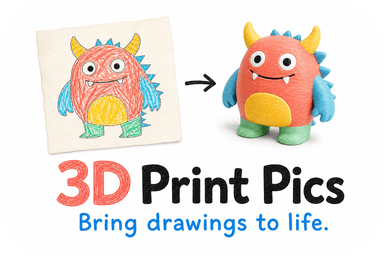
For most gifts, the best filament is PLA. That means keepsakes, figurines, ornaments, desk pieces, classroom models and miniatures that live indoors on a shelf or desk. PLA is the material guides recommend for indoor display items such as gifts and figurines. It holds fine detail, comes in a wide range of colors and has a smooth, attractive surface. If you would rather skip the materials homework, we print custom keepsakes from your photo or drawing in non-toxic PLA, with a 3D preview you approve before anything is printed.
TL;DR
- PLA is the right pick for gifts that sit indoors: figurines, pet memorials, kids' art keepsakes, mascots, trophies and school models.
- Color and finish matter more to a gift than raw strength. Plan the color before you plan anything else.
- PLA softens at around 60°C, so keep the gift away from hot cars, sunny windowsills and heaters.
- If the recipient is a child, check safety and finishing first: smooth edges, no tiny detachable parts, hand-wash only.
- Our custom models run $49.99 to $77.99, with up to 7 color choices in non-toxic PLA and a preview before printing.
Table of Contents
- Why this question matters for gift buyers
- What actually matters in a gift filament
- PLA: the default for keepsakes, figurines and models
- Color and finish: the part recipients notice
- Heat, sun and where the gift will live
- PLA versus PETG for a gift
- Light-through gifts and ornaments
- Safety for children's gifts
- If you print yourself: what spec sheets say
- Perspective
- Turn a photo or drawing into a gift
- How to choose for each occasion
- FAQ
- Sources
Why this question matters for gift buyers
Search results for this phrase are mostly written for people who own a printer. They compare spools, brands, nozzle temperatures and bulk bundles. That is useful if you are printing in your garage. It is less useful if you want to turn your daughter's dinosaur drawing, your dog's photo or a company logo into a present and want to know what it will be made of and whether it will last.
So here is the question reframed. A gift has four jobs: look good, survive handling, be safe for whoever receives it, and still look good years later. Filament choice affects each of those. Once you see how, the answer for nearly every personal keepsake is simple.
What actually matters in a gift filament
General material guides say the right filament depends on the intended use and on properties such as impact strength, flexural and tensile strength, hardness, heat behavior and elongation. A buyer's guide boils it down to the conditions the object will face: heat, sunlight, impact, bending and wear rule materials in or out faster than anything else.
For a gift, translate those into plain questions:
- Where will it live? On a bookshelf, a desk or a mantel is easy. A car dashboard, a porch or a backpack is harder.
- Who will handle it? An adult collector, a teacher, a six-year-old or a toddler each call for different care.
- What should it look like? Matte and crisp, glossy, or bright and bold?
- How long should it last? A seasonal ornament and a lifelong memorial have different expectations.
Most gifts answer the first question with "indoors, on display," and that is exactly where PLA is at its best.
PLA: the default for keepsakes, figurines and models
PLA (polylactic acid) is a plastic made from plant-based sources and is the most widely used filament for display pieces. A common description of it: a blend of plant-based materials and polymers with a lower melting temperature and little warping, which makes it a popular choice for displays and small household prints. Low warping matters for gifts because it keeps edges, faces and fine details true to the design.
Here is how PLA fits the gifts our readers ask about most.
| Gift | Why PLA suits it | What to keep in mind |
|---|---|---|
| Child's drawing turned into a figure | Holds bold outlines and bright colors | Pick colors that match the crayon palette |
| Pet memorial | Crisp shape and a calm, solid color | Display indoors, away from direct sun |
| Business mascot or logo | Clean edges and a consistent color | Choose size for the desk or counter |
| Tabletop miniature | Fine detail on small features | Choose a size that keeps small parts sturdy |
| School project model | Light, easy to handle, easy to display | Handle gently, keep dry |
| Teacher or PTA gift | Looks polished on a shelf | Order early for a fixed event date |
If you want to see how PLA compares with another popular approach to detail, our guide on PLA versus resin for your project walks through it in plain terms.
Color and finish: the part recipients notice
Nobody unwraps a gift and asks about tensile strength. They notice the color, the shine and how closely the piece resembles what it is meant to be. That is why color choice deserves more of your attention than the spec sheet.
Some practical color guidance for gifts:
- Children's art: Match the dominant colors of the original. A drawing with a green body and orange spots should come back green with orange spots. Keep the palette small, because a simple color plan reads better in three dimensions.
- Pets: Pick the closest coat color. Warm browns, creams, grays, blacks and whites are the usual starting points. A solid tone looks intentional and dignified on a shelf.
- Logos and mascots: Use your brand's main color. Contrast between the figure and the surface it sits on makes it pop in an office or at an event.
- Miniatures: Neutral colors take paint well if the recipient likes to customize.
Specialty finishes exist, such as glossy silk-style PLA, which has a glossy, vibrant finish. A glossy look can suit trophies and decorative pieces. For a faithful likeness of a drawing or a pet, a clean solid color is usually the better choice, since shine can blur small details in photos.
With us, you pick colors yourself: up to 7 color choices in non-toxic PLA, and you see a 3D preview before the print is finalized. That preview step is the best protection against a gift that looks nothing like what you pictured. Our walkthrough on previewing a child's drawing before printing shows what to look for.
Heat, sun and where the gift will live
This is the one place where PLA needs a little care, and it is worth knowing before you hand over the present. PLA softens at around 60°C, so parts left in a hot car or in direct sun can lose their shape. Sturdier materials exist for functional parts that face heat or outdoor weather, but a keepsake is not a bracket or a garden fixture. It belongs inside.
Simple care rules for the person receiving the gift:
- Display it indoors, away from sunny windowsills and radiators.
- Do not leave it in a parked car, especially in summer.
- Keep it away from candles, lamps with hot bulbs and heaters.
- Dust it with a dry, soft cloth.
For gifts being mailed, ship them in the box the print arrives in and tell the recipient where to place it. If you are shopping for a classroom or a front-desk display, choose a spot out of the afternoon sun.
If you are curious about how size and material choices change the feel of a large piece, a comparison of PLA and ABS for statues shows how makers weigh durability against display needs for bigger figures.
PLA versus PETG for a gift
Readers often ask whether PLA or PETG is better. PETG is a tougher, more heat-tolerant plastic that guides position for functional parts such as brackets and enclosures. That is the key: PETG is chosen for parts that work, bend and sit in warm places. A gift keepsake is a display object.
The decision is easy:
- Choose PLA for anything meant to be looked at: figurines, pet tributes, mascots, ornaments, school models, miniatures.
- Think about a heat-tolerant material only if the object must sit somewhere hot or outdoors, like a car accessory or a garden marker.
For personal keepsakes made from photos and drawings, PLA is the material that serves the purpose, and it is the one we use.
Light-through gifts and ornaments
Some gifts, such as lithophane-style ornaments, depend on light passing through the print. One guide notes that translucent or clear PLA lets light pass through, with the design tuned to the light source and thickness. That is a different kind of project from a solid figurine, where you want a rich, opaque color. If you are after a solid, three-dimensional likeness of a photo or drawing, that is what our process is built for.

Safety for children's gifts
If the recipient is a child, the material matters, but finishing and use matter just as much. PLA in its raw form is considered safe to handle, but a Prusa parents' guide points out that layered surfaces have tiny spaces where bacteria can collect. Its advice: clean the print with warm water and dish soap, and never put it in the dishwasher, because of the temperature.
A parents' checklist also recommends smoothing layer lines and burrs and rounding sharp corners to reduce weak points where a piece could snap.
Put together, a practical checklist for a child's gift:
- Shape: Choose a chunky, compact design over thin spikes, long tails or tiny attachments.
- Size: Go larger when the child is young, so no part is small enough to be a choking risk.
- Finish: Check that edges and surfaces feel smooth.
- Cleaning: Hand-wash gently with warm water and mild soap. No dishwasher.
- Supervision: Treat a keepsake as a keepsake. For toddlers, read our guidance on toddler-safe 3D prints first.
For wider reading, our pieces on safe 3D prints for kids, 3D printed toy safety and durable 3D prints for kids go deeper. Keep in mind that 3D prints are not made for food contact, a point we cover in why 3D prints are not food safe. A cup, a plate or a cookie cutter is the wrong gift for a printed object. A figurine is the right one.
The U.S. Consumer Product Safety Commission has also looked at the printers themselves. A staff report lists thermal, fire, electrical, mechanical and chemical hazards, including particulate emissions, which is one more reason to leave printing to a service with proper setup rather than printing at a kitchen table.
What "non-toxic" does and does not mean is worth understanding. Our explainer on non-toxic 3D prints covers the label, and non-toxic PLA at home and school covers ventilation and use.
If you print yourself: what spec sheets say
If you own a printer and want to make your own gifts, the research points to a few quality basics. Maker guides stress that filament should be dry and consistent in diameter, with the spool handled well, because poor handling causes stringing, rough surfaces and defects. Those details often decide how a print looks more than the material name does.
That is the real reason a gift made from a personal photo is hard to do casually. Turning a photo or a drawing into a printable model is the harder half of the job, long before filament comes into it. A flat image has no depth, no back and no thickness. Someone, or something, has to build all of that, and then you still have to print it cleanly in the right colors.
Perspective
We see the filament question as a gift question first. The person opening the box does not care which spool the piece came from. They care that it looks like the drawing, the dog or the logo they know.
That is why we print in non-toxic PLA. It suits the indoor display pieces our customers order, and it gives us a wide palette: up to 7 color choices, so a child's green-and-orange dinosaur can actually come back green and orange.
The step we care about most is the preview. Our AI builds a 3D model from the image you upload, and you approve it before printing starts. Color and size are yours to set. A gift should never be a surprise in the wrong way.
Our advice to every gift buyer: decide where the piece will sit, pick colors that match the original, and keep it indoors. Do those three things and the material has done its job.
Ian
Turn a photo or drawing into a gift
If you have a drawing, pet photo, logo or character illustration, you do not need to pick a filament or a printer. Upload the image to 3D Print Pics, choose your colors and size, and review the 3D model preview before you finalize. Custom models are priced from $49.99 to $77.99, and rush processing is an extra $10 if the date is close. Your print is made in non-toxic PLA and delivered to your door.

Start on the 3D Print Pics order page, or read how one photo becomes a no-scan figurine first.
How to choose for each occasion
- Birthday for a child: Pick a chunky figure from their own drawing, bold colors, and a size that is easy to hold.
- Mother's Day or Father's Day: A figure from a child's art makes a keepsake that stays on a desk for years.
- Pet memorial: A calm, solid coat color in a size that fits a shelf or side table.
- Teacher appreciation or end of year: A class drawing or the school mascot, ordered with time to spare. Rush processing helps if the deadline is tight.
- Corporate gift or promotion: The company mascot or logo in brand colors, sized for a desk.
- Tabletop gamer: A character illustration turned into a miniature in a neutral color that takes paint.
- Student project: A model from a sketch, in colors that make the idea clear to the class.
For each, the rule is the same: PLA, indoors, colors matched to the original, preview approved.
FAQ
What is the best filament for gifts?
PLA is the best filament for most gifts. It is recommended for indoor display items such as figurines, it holds detail well and it comes in a wide range of colors. Keep the finished piece indoors and away from heat.
Is PLA or PETG better for a gift?
For a keepsake that sits on a shelf, PLA is the better fit. PETG is typically chosen for functional parts that need extra toughness or heat tolerance, such as brackets and enclosures, which is not what a display gift does.
Is a PLA gift safe for a child?
PLA is safe to handle in its raw form, and ours is non-toxic PLA. For young children, choose a compact design without tiny parts, check that edges are smooth and wash it by hand with warm water and dish soap. Never use a dishwasher, and read our toddler guidance before giving a print to a very young child.
Can I leave a 3D-printed gift in the car or by a window?
It is best not to. PLA softens at around 60°C, so a hot car or strong direct sun can warp it. Display it indoors, away from radiators, candles and sunny sills.
Which colors should I choose for a custom print?
Match the original: the dominant colors of the drawing, the coat color of the pet or the brand color of the logo. Keep the palette simple, because clear color blocks read best in three dimensions. We offer up to 7 colors, and you see the preview before printing.
Sources
- Ultimate Filament Guide: PLA, PETG, ABS & ASA
- Materials Used in 3D Printing: Guide to 3D Printing Materials
- 3D printing filament buyer's guide
- Hatchbox PLA Gold 1.75mm product page
- 3D Printer Filament Guide: PLA, PETG & Co.
- Christmas Ball Lithophane guide
- DIY sensory play: 3D print your own accessories
- 3D Print Toy Parts Safely: Parent's Checklist
- CPSC staff report on 3D printing and 3D printed consumer products
- Things to Consider When Choosing 3D Printing Filament