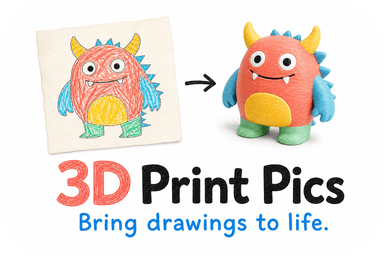
A 3D print is safe for a child when the material is a low-risk one like PLA, the shape has no small or sharp pieces for that child's age, the surface is finished smooth, and the part is strong enough to survive being dropped, chewed and thrown. The plastic matters less than most parents expect. Design, size and print quality decide more. Below is a practical checklist, the evidence behind it, and how we handle it when we turn a child's drawing into a keepsake.
TL;DR
- Material is only the first check. PLA is the usual choice for kids' items, but a print can still fail on small parts, sharp edges or weak layers.
- For children under 3, avoid anything with parts that could detach or fit in a mouth. Federal rules on small parts exist for a reason.
- Look at the finished object: smooth surfaces, rounded corners, no thin spikes, no support-material stubs.
- A 3D print is a keepsake or display piece, not a certified toy, and not food safe.
- Ask any seller for a preview, the material, and the size before you pay.
Table of Contents
- What "safe" means for a 3D print
- The material question: PLA, ABS, resin and additives
- Small parts, sharp edges and breakage
- Age guide at a glance
- If a printer is in the house or classroom
- A buyer's checklist for safe 3D prints for kids
- Our view: a safe print starts with the design
- Turning a child's art into a keepsake you can feel good about
- Finishing and care at home
- FAQ
- Sources
What "safe" means for a 3D print
Parents usually ask one question: is the plastic toxic? That is only one of four separate questions:
- Material: what is the object made of, and does it contain additives?
- Shape: can a piece break off, or can the whole object fit in a small mouth?
- Surface: are there sharp edges, rough layers or leftover support stubs?
- Making: were the printer settings good enough that the part is actually strong?
The US Consumer Product Safety Commission (CPSC) looked at this in its evaluation of 3D printers. In testing, some 3D-printed products released small parts during use-and-abuse testing, and CPSC staff recommends caution about incorrect printing parameters or materials. The same report reports a 36.7% failure rate across 398 3D-printed children's product samples tested against the ASTM F963-17 toy standard's use-and-abuse tests. That is not a reason to avoid 3D prints. It is a reason to look at shape and build quality instead of assuming that "non-toxic" settles everything.
The report also says consumer- or microbusiness-produced children's products may not meet applicable regulations or voluntary standards, because producers may not know those rules exist. So ask the seller what the item is meant for.
The material question: PLA, ABS, resin and additives
Most custom keepsakes are printed in PLA, a plastic made from plant-based starch sources such as corn. It is the common filament for kids' projects because it prints at lower temperatures and is easy to work with. Our own prints use non-toxic PLA.
Two cautions keep that in proportion:
- Printing and wearing are different risks. The EPA notes that PLA and ABS filaments release different amounts of respirable particles, and that specialty filaments with additives such as metal particles or metal-containing flame retardants may pose additional health risks. Those emissions come from the printer while it runs. They are a reason to keep a printer away from children, not a reason to fear a finished, cooled PLA object.
- Additives change the picture. Glow, metallic, wood-fill or carbon-fiber filaments are not the same as plain PLA. For anything a child may mouth, stick to plain, solid-color PLA.
A 2025 systematic review of exposure in 3D printing found that total VOC concentrations for common filaments, including PLA, ABS, TPU and PETG, exceeded permissible exposure levels. Again, this is about the printing environment. If you are buying a finished piece, the printing happened elsewhere. If you are printing at home, it matters a great deal.
Our longer piece on when non-toxic PLA isn't safe at home or school covers the emissions side. For the material choice itself, see PLA vs resin.
Why resin prints need extra care
Resin printing involves liquid chemicals, and parts must be washed and cured. NIOSH's makerspace guidance notes that acetone can irritate eyes and the respiratory tract, while chloroform can depress the central nervous system and is possibly carcinogenic. Those solvents show up in post-processing. The same guide describes support materials removed in a 2% sodium hydroxide bath at pH 13, which is corrosive and can cause chemical burns. For a child's hands, a properly finished PLA piece is the simpler choice.

Small parts, sharp edges and breakage
This is where most real-world harm comes from, so check it first.
Children under 3
The federal small parts ban covers products intended for children under three. According to the CPSC, it aims to prevent choking, inhaling or swallowing of small objects. A 3D-printed keepsake is not automatically a toy, but a baby or toddler does not know that. If the child is under 3:
- Skip figures with ears, tails, horns, antennas or fingers that could snap off.
- Choose one solid, chunky piece rather than an assembled model.
- Keep it larger than anything that could fit in a mouth. If unsure, go bigger.
- Treat it as a shelf item they look at with you, not something for the crib or the car seat.
Ages 3 and up
Older kids still bite, bend, drop and throw. PLA is rigid and can crack and leave a sharp edge. Printed objects are built in layers, and layers can split along their seams, especially on thin parts. Look for:
- Thickness: thin limbs, thin wings, thin letters and long spikes are the weak points.
- Rounded ends instead of points.
- No visible cracks, loose strings or burrs.
- No support stubs: small nubs left where temporary supports were snapped off.
For a drawing turned into a figure, simple solid shapes are safer than faithful recreations of every thin line. We explain how that trade-off looks on screen in how a child's drawing becomes a 3D toy.
Age guide at a glance
| Child's age | What to choose | What to avoid |
|---|---|---|
| Under 3 | A large, solid display piece you hold with them | Any small or detachable part, thin protrusions, anything for the crib |
| 3 to 5 | Chunky, rounded figures; supervised handling | Thin limbs, sharp tips, anything that has cracked |
| 6 to 12 | Display pieces, desk figures, name tags, models | Unsupervised use of a printer or finishing tools |
| Teens | Same as above, plus hands-on printing with adult setup | Printing in a closed bedroom without ventilation |
This table is our practical guide, not a regulation. For toys made for the under-3 group the federal rules apply, and a keepsake from us is not sold as a certified toy.
If a printer is in the house or classroom
Some families and teachers want to print at home. Then the risk moves from the object to the machine. The EPA notes children may be vulnerable to 3D printer emissions and may be exposed to high concentrations of particles when printers run without controls in confined spaces such as classrooms and libraries. EPA researchers modeled particle deposition in children from three months to eighteen years and found the greatest predicted mass deposition in the nine-to-eighteen range.
NIOSH's 2024 bulletin recommends a risk-management plan built on the hierarchy of controls, which puts eliminating or substituting hazards first, then proper ventilation and HEPA filtration. It also lists burns from hot surfaces, noise and electrical hazards as concerns. In plain terms:
- Put the printer in a ventilated space the child does not sleep or play in.
- Enclose it where possible. The Washington State Department of Health says printers should ideally be enclosed and exhausted directly outdoors.
- Keep kids away from the hot nozzle and bed.
- No eating, drinking or gum near the printer, and wash hands after use, as the same department advises.
- Use a removable build surface with glue stick or painter's tape, so no one pries parts off with blades, another recommendation from that agency.
The simplest control on this list is substitution: have the part printed somewhere else and delivered finished. That is one reason many teachers and parents order prints instead of running a machine.
A buyer's checklist for safe 3D prints for kids
Before you order from anyone, including us, ask:
- What material is it, and is it plain, solid-color PLA? Avoid unknown additives for kids.
- Can I see a preview? A 3D preview shows thin parts before anything is made.
- What size is it? Size tells you whether it could be a choking hazard.
- Is it sold as a toy? If not, treat it as a keepsake. Certified toys go through specific testing.
- Is it a display piece or a food piece? Never use a print as a cup, plate or bottle part. Our guide on food safety for 3D prints explains why layered plastic is hard to clean.
- What happens if it breaks? Throw cracked pieces away. Do not give a child a part with a sharp split.
For a broader parent-focused overview, see 3D printed toy safety: what parents need to know.
Our view: a safe print starts with the design
We make keepsakes from photos, drawings and logos, and the safest decision comes before any plastic is melted. A child's drawing often has delicate lines: a stick-thin arm, a spiky sun, a long tail. Printed faithfully, those are the pieces that snap. So we think about a print as a physical object, not a picture with depth.

That is why the preview step matters to us. You see the 3D model and pick colors before anything is made, which lets you spot a thin or pointy part and decide whether it suits your child's age. We use non-toxic PLA and offer up to 7 color choices, and you choose the size. For a child under 3, we would tell any family the same thing we say here: choose a chunky, simple shape, keep it large, and treat it as a keepsake you share together.
We also do not claim a print is a certified toy or food safe. It is a personalized memory in plastic, and the honest way to sell one is to say what it is for.
— Ian
Turning a child's art into a keepsake you can feel good about
If you want a safe, personal piece, our service starts with an image: a child's drawing, a pet photo or a logo. You upload it, pick colors, review the 3D preview and approve before the order is finalized. Custom 3D models cost $49.99 to $77.99, and rush processing is an extra $10. Prints are made from non-toxic PLA and delivered to your door.

When you order, keep the checklist above in mind: choose a simple, rounded design, a size that suits your child's age, and a solid color. You can start on our custom 3D models page. Teachers can also see how school projects move from art to keepsakes.
Finishing and care at home
A safe print stays safe only if you look after it.
- Inspect it on delivery and again after any drop. Look for cracks along the layer lines.
- Clean it with a damp cloth. Do not soak it or scrub it in a way that roughens the surface.
- Keep it away from heat. A hot car can soften PLA and warp it into a different shape.
- Do not sand a print with a child nearby. Sanding creates fine dust.
- Retire damaged pieces. A cracked part can leave a sharp edge. A chewed corner can break off.
If you are printing yourself, the Washington State Department of Health's advice to avoid sharp tools for removal is worth following. Use a build surface designed to release parts without prying.
FAQ
Is PLA safe for kids?
PLA is the usual choice for children's keepsakes and school projects, and the finished, cooled object is a low-risk material when it is plain and solid in color. The main risks are shape and strength, not the plastic itself. Printer emissions during printing are a separate matter and call for ventilation and distance.
Are 3D prints safe for toddlers?
Only with great care. Children under 3 put things in their mouths, and federal rules exist to prevent choking on small parts. Choose a single, large, solid piece with no thin protrusions, and use it under supervision rather than as a toy left in a crib or stroller.
Can a child chew on or play with a 3D print?
We do not recommend it. Prints are built in layers, which can split, and PLA is not made or tested as a teething item. Treat prints as display and keepsake pieces. If you want something for play, look for products sold and tested as toys.
Are 3D prints food safe?
No. The layered surface can trap residue and microbes, so you should not use prints as cups, plates or utensils. Our article on why 3D prints are not food safe goes into the details.
Should I let my child use a 3D printer?
Only with an adult in charge of setup, and in a ventilated place. The printer has a hot nozzle and bed, and agencies such as NIOSH and the EPA flag burns and particle emissions as concerns. For younger kids, designing and previewing a model together and having it printed elsewhere removes most of that risk.
Sources
- Lifecycle Evaluation of 3D Printers, US Consumer Product Safety Commission
- Small Parts and Choking Hazard Labeling FAQs, CPSC
- 3D Printing Research at EPA, US EPA
- Approaches to Safe 3D Printing: A Guide for Makerspaces, NIOSH
- Safe 3D Printing is for Everyone, Everywhere, NIOSH
- 3D Printers, Washington State Department of Health
- A global evaluation of exposure to pollutants in 3D printing, ScienceDirect