Most 3D-printed objects are not safe for repeated direct food contact, even when printed in a filament marketed as food safe. Limited single-use or indirect contact can be acceptable if the material is certified for food contact, the printer and nozzle are dedicated and clean, the part is properly sealed or coated, and you follow a validated sanitization routine. The sections below walk through the materials, the risks, and the exact steps that make the difference.
TL;DR:
- Most 3D-printed objects are not inherently food safe due to microscopic layer gaps that trap bacteria and moisture, especially with FDM or porous SLS structures.
- Food-contact filaments like PLA and PETG require proper validation, dedicated equipment, and thorough sanitization routines, but finished parts remain susceptible to contamination.
- Coatings such as food-grade epoxy or wax help reduce porosity but can crack or wear over time, making periodic inspection essential for safety.
- Resin prints are generally unsafe for direct food contact due to residual uncured chemicals, with only specialized, tested food-safe resins being suitable if properly cured.
- Reuse increasingly raises risks, so treating 3D-printed food-contact items as disposable or short-term use objects is the safest approach.
Table of Contents
- Why most 3D-printed parts are not food-safe by default
- Material-by-material guidance: PLA, PETG, nylon, PP, and high-temp polymers
- SLA resins: cure, leachables, and why most hobby resins are poor choices for food contact
- Coatings and finishes: what helps, what fails, and realistic testing expectations
- Research-backed best practices: design rules, print settings, and sanitization protocol
- Practical author perspective: balancing maker creativity with food-safety obligations
- How to get a safe, attractive custom keepsake from 3D Print Pics
- Sources
- FAQ
Why most 3D-printed parts are not food-safe by default
A print's danger rarely comes from the plastic alone. It comes from the shape the printing process leaves behind. Fused deposition modeling (FDM) builds objects in stacked layers, and even a smooth-looking surface hides microscopic gaps between those layers. Those gaps trap moisture, sugars, and food particles, giving bacteria a place to settle in and multiply where no amount of wiping can reach, according to extension guidance on 3D-printed parts for food contact. Selective laser sintering (SLS) parts have their own version of the problem: the powder-fused structure is inherently porous and absorbs liquids rather than shedding them.
Contamination can also come from the machine itself, not just the part.
- Brass nozzles sometimes contain lead or other metals that can migrate into the extruded plastic at high temperatures.
- PTFE liners inside hot ends can degrade with age and shed particles into the filament path.
- Dust, lubricant residue, and leftover filament from non-food prints can contaminate a print bed or nozzle that is not dedicated to food use.
These risks compound with reuse. A single-use item that touches dry food briefly and gets thrown away carries far less risk than a cup or utensil washed and reused daily, because repeated wetting and drying cycles let bacteria build up inside the layer lines over time. The extension guidance referenced above frames food-contact 3D printing as reasonably viable for prototyping or one-time use, but difficult to make truly sanitary at a hobbyist level without following stricter sanitary design standards meant for production equipment.
Material-by-material guidance: PLA, PETG, nylon, PP, and high-temp polymers
Not all filaments carry the same risk profile, and reading a supplier's food-contact statement correctly matters as much as picking the right polymer.
- PLA: FDA Food Contact Notification documents show PLA has been the subject of submissions proposing clearance for food-contact use under defined conditions, though finished-article makers remain responsible for validating their own parts, per FDA food contact documentation for PLA. PLA softens at low temperatures, so it suits short, cool, low-contact uses rather than anything hot or long-lasting, and colorants or additives can change its safety profile entirely.
- PETG: Offers better chemical and heat resistance than PLA, which makes it more tolerant of warm water, but dishwasher cycles and repeated washing still stress the layer bonds and any added pigments remain largely untested for food contact.
- Nylon and PP: Both resist grease and higher temperatures well, which suits kitchen tools in theory, but they are harder to print cleanly and tend to warp or trap moisture, so porosity control matters even more than with PLA or PETG.
- PEI and PEEK: These industrial polymers are used in food-processing equipment, but only with specialist high-temperature printers and controlled finishing. They are not realistic choices for a typical desktop setup.
When a filament supplier states "food safe" or references compliance testing, that claim usually applies to the raw resin pellets, not your finished printed object. A resin supplier's own documentation, such as Luminy PLA's food-contact statement, details overall migration limits and conditions of use at the material level. The manufacturer of the final part, meaning you, still has to confirm the geometry, finish, and use case hold up under those same conditions.
SLA resins: cure, leachables, and why most hobby resins are poor choices for food contact
Stereolithography (SLA) and similar resin printing introduce a different hazard entirely: uncured liquid resin and residual solvents. Standard hobby resins contain photoinitiators and monomers that remain partially uncured even after a typical post-cure cycle, and those leftover chemicals can leach out on contact with food or drink. A handful of resins are manufactured and tested specifically for food contact, but these are distinct products from the general-purpose resins sold for miniatures and prototypes, and they require documented post-cure times and UV exposure to be trusted.

Without that documentation and testing, there is no reliable way to confirm a cured resin part is safe to touch food. SLA printing is far better suited to making molds, masters, or jigs used to shape other food-safe materials than to producing parts that touch food directly.
Coatings and finishes: what helps, what fails, and realistic testing expectations
A coating can reduce the porosity that makes raw FDM prints risky, but only certain ones qualify and only when applied and maintained correctly.
- Food-grade epoxies, shellac, food-grade wax, and some polyurethanes are cited as viable sealants in extension guidance on food-contact prints.
- Coatings fail through flaking, pitting, or cracking over time, and a cracked coating can trap bacteria worse than an uncoated surface, according to the same extension fact sheet.
- A coated part should be checked periodically for surface damage, especially after dishwasher cycles, hot liquids, or abrasive scrubbing, since any of those can compromise the seal.
Pro Tip: Inspect a coated print under bright light every few uses. If you can see dulling, hairline cracks, or lifted edges, retire the part rather than recoat it.
Coatings are a reasonable tool for low-risk, short-term use, not a shortcut to injection-molded safety. A sealed PLA bowl is still a 3D print underneath, and the coating only buys time before wear exposes the layer lines again.

Research-backed best practices: design rules, print settings, and sanitization protocol
A few concrete habits lower the risk meaningfully if you choose to print anything that will touch food.
- Design for drainage and strength: print at 100% infill, round internal corners to at least a quarter inch, and slope surfaces so liquid cannot pool, following design rules in extension guidance.
- Set up a dedicated machine: use a low layer height for tighter layer bonding, a stainless steel nozzle instead of brass, and keep filament and the printer itself reserved only for food-contact prints.
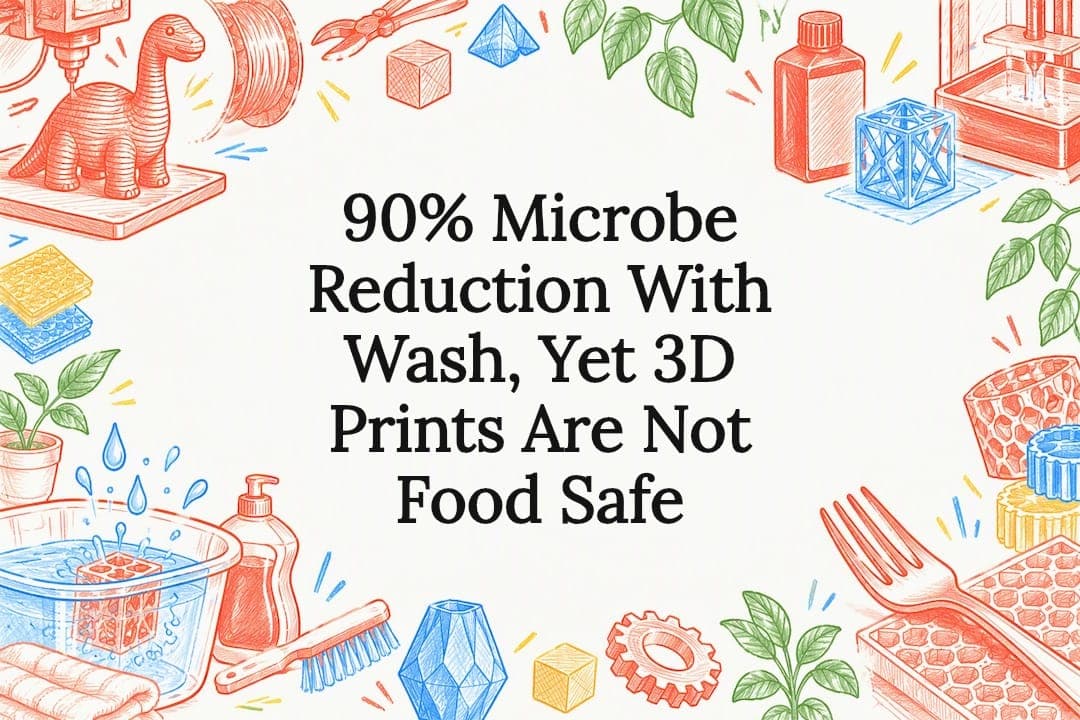
- Sanitize with a validated method: wash in warm soapy water at 120°F with a baking-soda scrub, which a controlled study found reduced microbial load by around 90% in both PLA and PETG samples.
- Add a chemical step for extra assurance: a 2-minute soak in 200 parts-per-million bleach solution, or a wipe with 70%+ isopropyl alcohol, brought pathogen levels down further in the same research.
- Know when to stop reusing a part: retire any print after contact with hot liquids, baby food, or extended soaking, since these conditions stress layer bonds and coatings fastest.
90% CFU/PFU reduction was the result researchers measured after a warm soapy wash and baking-soda scrub on printed PLA and PETG samples, according to the sanitation effectiveness study. That number is encouraging, but it describes a controlled test, not a guarantee for every home setup, filament batch, or printer.
Practical author perspective: balancing maker creativity with food-safety obligations
The honest framework is simple: treat 3D-printed items as disposable or dry-use by default, and reserve anything wet, hot, or repeatedly washed for materials you can actually certify. When in doubt, a print makes a better mold for casting a real food-safe object than a utensil in its own right. For keepsakes and decorative pieces where food never enters the picture, non-toxic PLA from a service like 3D Print Pics sidesteps the whole question, since those objects were never meant to touch a plate.
— Ian
How to get a safe, attractive custom keepsake from 3D Print Pics
When the goal is a personal object rather than something that needs to survive a dishwasher and a dinner plate, a managed print removes the guesswork entirely.

- Upload a photo, drawing, or logo and get an AI-generated model preview before you commit to anything.
- Choose from up to 7 color options in non-toxic PLA and pick the size that fits your space or gift.
- Skip the nozzle swaps and sanitation routines: production handling and material consistency are built into the process.
Custom 3D models run $49.99 to $77.99 one-off, with rush processing available for $10 one-off, at 3D Print Pics.
Sources
For deeper reading, check the extension fact sheet on food contact, FDA food contact documentation, the sanitation effectiveness study, and your filament's own food-contact statement, such as Luminy PLA's, before relying on any print for food use. For a sense of typical consumer prints and their design limits, see this 3D-printed desk organizer as an example of finished-part quality.
- Sanitation Effectiveness of 3D-printed Parts for Food and Medical Applications
- 3-D printed parts for food contact (Oklahoma State University extension)
- FDA food contact documentation for PLA (FCN-related submission)
- TotalEnergies Corbion food-contact statement for Luminy® PLA
FAQ
Is there any 3D print material that is food safe?
PLA and PETG are the materials most often cited for food-contact potential, and PLA has been part of FDA food contact notifications, but the finished printed part still needs proper design, a clean dedicated setup, and validated sanitization to be considered reasonably safe, as outlined in FDA documentation. No filament label alone makes a finished print food safe.
Is PLA or PETG better for food safe use?
PETG generally resists heat and chemicals better than PLA, making it slightly more tolerant of warm water and washing, while PLA's main appeal is its lower printing temperature and simpler handling. Neither is inherently safer without 100% infill, smooth surfaces, and the sanitization steps described in the sanitation effectiveness study.
Is 3D printed food safe to eat?
Edible 3D printing uses food-grade pastes like chocolate, dough, or purees extruded directly through a specialized food printer, which is a separate category from printing plastic objects meant to hold food. If you mean plastic parts used to shape or contain food, they carry the same porosity and sanitation concerns covered above and are not inherently safe just because the final output is edible.
Is PETG ok to drink out of?
PETG has better heat and chemical resistance than PLA, but a printed PETG cup still has the same layer-line gaps that trap bacteria over repeated use, according to extension guidance. It is a reasonable choice for occasional cold-drink use with a validated cleaning routine, not for daily reuse without a sealed, food-grade coating.