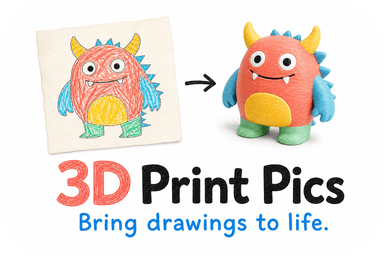
If you took the photo, drew the picture, or own the logo, you can turn it into a custom gift. If someone else took the photo, you need that person's permission first, even when the picture shows you, your child or your pet. Owning a copy of an image and owning the right to copy it are two different things.
That one distinction settles most cases. Below you will find who owns a photo, what permission looks like, when the people in a picture matter, and a short checklist to run before you upload anything. If your source is your own phone photo, your child's drawing or your own logo, you are in the simplest position, and our custom 3D models start from exactly that kind of image.
TL;DR
- The person who presses the shutter owns the copyright in a photo, not the person who is in it or who paid for prints.
- Your own photos, your child's artwork and your own logo are the safest things to turn into a gift.
- A professional's photo (school portraits, wedding, pet studio) usually needs the photographer's written permission before you reproduce it in a new form.
- Gifts you sell or use to promote a business raise the bar: you may also need a release from any recognizable person.
- Keep a dated note of where each image came from and who said yes.
Table of Contents
- Who owns a photograph
- Why a 3D keepsake still counts as copying
- What the safest sources look like
- When someone else took the photo
- People in the picture
- Personal gift versus selling or promoting
- A five-step check before you upload
- How the ordering process fits
- Our perspective
- Ready to turn your image into a keepsake
- FAQ
- Sources
Who owns a photograph
The U.S. Copyright Office states that the person who takes a photograph owns its copyright, whether or not that person is a professional. Copyright begins the moment the picture is saved in a fixed form, such as a digital file. No registration or notice is needed for it to exist.
The same guidance covers the case many gift shoppers fall into. Owning a photo someone else took does not give you its copyright, even if the photo shows you. You can give the print away or sell it as an object. You do not, however, get the right to make and distribute copies of it or publish it.
A few everyday examples:
- Your own phone snapshot of your dog: you own it. Print away.
- A selfie a friend took of you both: your friend owns it. Ask before you reproduce it.
- A photo from a professional session or school picture day: the photographer owns it, unless a contract says otherwise.
- A photo you found online: the person who made it owns it. Being easy to download does not change that.
Copyright covers a bundle of rights, including copying, adapting and distributing. A photographer can keep some and hand others to you, which is why the wording of any permission matters.
Why a 3D keepsake still counts as copying
It is tempting to think that turning a flat photo into a sculpted figure makes it a new thing. A custom 3D model built from a photo starts by reproducing the photo's content: the pose, the face, the composition. The Australian Copyright Council explains in its photography guide that scanning or digitizing a photograph reproduces it and generally needs the owner's permission. It adds that a new work that borrows a distinctive part of a photo can have its own copyright, but you still need the original photographer's permission to reproduce it. That guidance is Australian, but the logic of reproduction is the same in the U.S., where the right to make copies sits with the copyright owner.
So the question is never "how much did we change it?" The question is "whose picture did we start from, and did they agree?"

What the safest sources look like

Your own photos
A photo you took yourself is yours to use. Anyone can take the picture that matters most: a first day of school, a dog asleep on the couch, a toddler holding a fistful of dandelions. For pet memorials this is usually the easiest route, because the best photos are the ones the family took at home. Our guide to photo requirements for 3D printing explains what makes an image work for a model.
Children's drawings and school projects
A drawing your child made is their work. As the parent, you are the natural person to approve turning it into a keepsake. For classroom projects, a teacher or PTA organizing a group order should have each family's agreement to use their child's artwork. The same applies if the art is going on anything shared, such as a fundraiser item. Our post on school 3D printing walks through that process in four steps.
Your own logo or mascot
If your business created its logo or mascot, or paid a designer under an agreement that transfers the rights, you can reproduce it on promotional items. If a freelancer designed it, check that your contract gave you the rights and not only a copy of the files. For what a logo registration does and does not protect, see our article on 3D printed logos and trademarks.
Characters, fan art and famous images
A character from a film, game or comic belongs to its owner. Printing it as a personal gift and selling it are different situations. We cover that ground in 3D printing fan art: what US makers need to know, and it is the right place to start for tabletop miniatures based on existing characters. Original characters you invented are yours.
When someone else took the photo
This is the case that causes the confusion: the wedding portrait, the school photo, the photo of your late pet taken by a studio. You have two sensible paths.
- Check what you already have. Many photographers include a print release or a license with the delivered files. Read it for what it allows: personal printing, gifting, social sharing, and what it prohibits.
- Ask in writing. The Digital Media Law Project advises that you identify the copyright owner and request permission for the specific use, stating your reason and what you intend to do.
A short, specific email works well. Say what the picture is, that you want a one-off 3D keepsake as a personal gift, and ask for a reply that says yes. Most working photographers are used to such requests, and many say yes to a private gift. Crediting and consent practices are laid out well in this guide to crediting photographers and subjects.
What a good permission covers
Permission does not need to be long, but it should be specific. A photographer's license or print release typically names the images covered, the permitted uses, the duration and any limits. Useful things to include in your own request:
| Point | What to write |
|---|---|
| The image | File name, session date or a description |
| Your use | One personal 3D printed keepsake, given as a gift |
| Quantity | One piece, or the number you need |
| Alterations | That the image will be converted into a 3D model |
| Credit | Whether the photographer wants a credit |
| Commercial use | Yes or no, stated plainly |
A licence can be oral or written, but writing leaves a record. The Australian Copyright Council notes that an exclusive licence or an assignment must be in writing and signed to be fully effective in Australia. Even in places where it is not required, an email reply is a cheap way to protect yourself.
People in the picture
Copyright belongs to the photographer. A separate set of rights protects the people shown. The National Library of Medicine explains that a person's publicity right means their image may not be commercially exploited without consent. Using a photograph in advertising can mean a license from the photographer and, unless a signed release covers it, permission from the person pictured.
Stanford's Copyright and Fair Use Center says that a release is needed when a name or image appears while a product or service is being sold or endorsed, but not if the person cannot be recognized. When in doubt, it recommends a signed release.
What that means in practice:
- A gift for a family member: a private gift is not a sale or an endorsement. Still, if the photo is of a relative, a quick "is this okay?" is good manners.
- A gift you sell, such as a class fundraiser or a shop item: recognizable faces call for signed releases. For children, a parent or guardian signs.
- Business mascots and promotional items: if real people are the model for the figure, get their release in writing. A mascot you invented from scratch avoids the question.
- Pets: pets do not have publicity rights. The photo's copyright still applies, so the rules above about who took the picture are what matter.
Personal gift versus selling or promoting
A one-off keepsake given to someone you love is the lowest-stakes use. Things change once money or marketing enters. The U.S. Copyright Office's 2025 fair-use summary of Chosen Figure v. Kevin Frazier Productions shows how a court treated a full, unchanged reproduction of a photograph in a commercial setting: all four fair-use factors weighed against the user. The lesson for gift makers is that a copy of a whole image, used commercially, is hard to defend as fair use.
If you plan to sell or give away items to promote a business, assume you need the owner's permission for each image that is not yours. Licensing bodies treat merchandise, such as prints and gifts, as a use for which a licence from the copyright owner may be needed.
A five-step check before you upload
- Who made the image? If you, your child or your company did, go ahead. If not, move to step 2.
- Do you hold a license or print release? Read it for personal printing, gifting and alterations.
- If not, ask. Use the table above and keep the reply.
- Who is recognizable? For private gifts, a courtesy check is enough. For anything sold or promoted, get signed releases.
- Save a record. Keep the original file, the permission email and the date in one folder. A documented permission for every photo you do not own is the habit professionals recommend, as this publishers' guide says when it covers how to respond to a copyright demand.
If an image comes from a stock site, screenshot the terms of use that day, since they can change.
How the ordering process fits
With us, you upload a picture, choose your colors and see a 3D model preview before you finalize the order. That preview step is a natural moment for the checks above: you are looking at the exact image you chose, so confirm it is one you have the right to use before you approve it. Our own artwork and copyright policy sets out how we handle artwork and copyright, and it is worth a read before your first order.
A few practical points from the ordering side:
- Parents and teachers can start from a child's drawing, which the family already owns.
- Pet owners can start from a favorite home photo.
- Businesses can start from their own logo or mascot artwork.
- The preview lets you approve the result before the order is finalized. Our guide to turning a photo into a 3D model in three clicks shows the steps.
Our perspective
Most people who write to us are not trying to push any legal boundary. They have a drawing on the fridge, a photo of a dog that is no longer here, or a logo they designed for a new shop, and they want to hold it in their hands.
Our advice is simple: start from what is yours. Your child's artwork, your own snapshots and your own logo are the cleanest starting points, and they are also usually the most meaningful. When the image came from a photographer, a short written yes protects the gift and the relationship.
We built the process around a preview you approve, in up to 7 colors of non-toxic PLA, because a keepsake should be something you are sure about before it is made. Take the same care with the image itself, and the finished piece is one you can display, give and keep without a second thought.
Ian
Ready to turn your image into a keepsake
Our custom 3D models are priced from $49.99 to $77.99, depending on the model, with optional rush processing for $10. You upload the image, pick colors and sizes, check the preview and then order. Prints are made in non-toxic PLA and delivered to your door.

If you already have an image you own, start your custom 3D model and see the preview. For a quick idea of what works well for a wall or desk, see our photo-to-3D figurine guide.
FAQ
Do I own the rights to a photo of myself?
Not automatically. The U.S. Copyright Office says the person who took the photograph owns the copyright, even when the photo is of you. You can keep and display the copy, but reproducing it in a new form needs the photographer's permission.
Can I print a school or studio portrait as a gift?
Usually only with permission. Check the release that came with your photos for personal printing and gifting. If it is silent, email the photographer, describe the one-off gift and keep the reply.
Do I need permission to make a gift from my child's drawing?
A drawing your child made at home is theirs, and you can decide on a keepsake as their parent. For group orders at school, such as a PTA project, get each family's agreement before you use their child's artwork.
Does it matter if I am only giving the gift, not selling it?
Yes, it lowers the risk but does not remove the need for permission when someone else owns the photo. Selling or promoting a business with the item raises the bar further: you may need the photographer's license and signed releases from recognizable people.
Sources
- U.S. Copyright Office: Photography
- Australian Copyright Council: Photography & Copyright
- Digital Media Law Project: Getting Permission to Use the Work of Others
- National Library of Medicine: Privacy and Publicity Rights
- Stanford Copyright and Fair Use Center: When to Use a Release
- U.S. Copyright Office: Chosen Figure v. Kevin Frazier Productions summary
- DACS: License artwork and get copyright permission
- AAN Publishers: Demand letters for copyright infringement and photos
- Crediting photographers and subjects