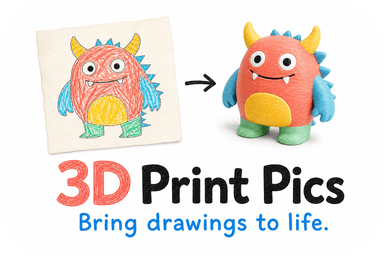
A 3D print turns a flat drawing or photo into an object you can hold, display and hand to a grandparent. It does not replace the original, and that is its strength: the paper stays safely in a folder while the shape, outline and colors of the artwork live on as a durable model. For parents, teachers, pet owners and gift givers, we make that route simple: upload the image, pick colors, approve a 3D preview, and the print arrives at your door.
TL;DR
- A print preserves the shape and look of a drawing, photo or logo as a physical object. It does not reproduce the original's paper, crayon or paint.
- Keep the original and the digital files. Museums treat files as documentation because an identical reprint later is not guaranteed.
- Our custom 3D models cost $49.99 to $77.99, with optional rush processing for $10.
- Display prints indoors, away from heat, damp and strong sun, and PLA will do its job as a keepsake.
- Clean, high-contrast images with clear outlines convert best.
Table of Contents
- What "preserving" art with 3D printing really means
- How a flat image becomes a 3D object
- Which artwork preserves best
- What a print keeps and what it cannot
- Who uses prints this way
- Color and finish
- Making a keepsake last
- Keep the files too
- Perspective
- Turn a drawing into a keepsake
- FAQ
- Sources
What "preserving" art with 3D printing really means
Museums and families mean different things by preservation. Conservators use 3D printing to reproduce missing or fragmented parts and to rebuild lost objects in archaeology, architecture and sculpture, according to a 2022 academic overview. At a Dutch museum, a textured replica of a Rembrandt painting let visitors touch and feel the brushwork while the original was being restored.
For a family the goal is gentler. A child's dinosaur drawing will yellow, crease and fade. A printed version captures the silhouette, proportions and color choices at a moment in time, and it can sit on a shelf where paper cannot.
The honest framing is that a print is a faithful companion to the original, not its twin. Researchers studying heritage reproductions note that a plastic print cannot reproduce the original object's materiality. Crayon wax, pencil shine and paper grain stay with the paper. What carries over is the form and the personality.

How a flat image becomes a 3D object
The general workflow is the same everywhere: create a digital model, slice it into layers, and build the object layer by layer. For a flat image there are two common ways to get the model. One converts brightness into height, making a raised relief with a base. The other builds a full freestanding figure from the outline. If you want the relief idea explained, see our guide to 2.5D relief 3D prints. If you are weighing a photo against scanning an object, our photo vs 3D scan comparison shows which route gives a printable model.
On our site the steps are short:
- Upload the image. A drawing, pet photo, logo or character illustration works.
- Choose colors and size. You can pick up to 7 colors in non-toxic PLA.
- Review the 3D preview. Our AI generates the model so you can see it before you commit.
- Approve and order. The print is made and delivered to your door.
If you want help choosing, our color choices guide walks through matching a drawing's palette.
Which artwork preserves best
Not every image gives the same result. Accuracy depends on image or scan quality, geometry cleanup, scale, printer settings and finishing, so the input matters.
| Source | What carries over well | Tip |
|---|---|---|
| Child's drawing | Bold outlines, simple shapes, character | Photograph flat in even daylight, no shadows |
| Pet photo | Pose, ears, tail, overall silhouette | Use a side or three-quarter view with the whole body visible |
| Logo or mascot | Clean edges, flat color blocks | Use the highest-resolution file you have |
| Tabletop character art | Distinct poses and costume shapes | Pick one pose, avoid overlapping limbs |
Fine pencil shading and very thin lines are the hardest parts to turn into plastic, so a drawing with confident outlines usually looks best. A resolution as small as a phone photo is fine if the image is sharp and well lit.
What a print keeps and what it cannot
Keep expectations clear and you will love the result.
It keeps: the shape, proportions, the arrangement of colors, and the charm of a hand-drawn line turned into a form. It also keeps the idea alive in a way that survives a move, a spill or a sibling with scissors.
It does not keep: the texture of the medium, the date written in the corner, or the feel of the paper. Cooper Hewitt's conservation team also found that a replacement print would not be identical to an earlier print, because materials, software and printer behavior change over time. That is why we suggest you treat the first print as the keepsake and keep the files and the original alongside it.

A good habit is to label the back or base with the artist's name and age. Heritage researchers recommend identifying reproductions clearly, and for a family that label becomes part of the story.
Who uses prints this way
Parents and grandparents
A kindergarten drawing at age five becomes a shelf piece at age fifteen. Grandparents often ask for a duplicate, which makes a ready-made gift.
Pet owners
A photo of a pet turns into a small figure that captures the pose you remember. Choose a photo that shows the animal's characteristic stance rather than a close-up face.
Teachers, PTAs and homeschool families
Class artwork can become a display set or a fundraiser item. Research in Colombia found that 88% of first-year undergraduates, 77% of ages 13 to 17 and 81% of children ages 6 to 12 chose 3D printing as a motivating learning method. Our school 3D printing guide lays out four steps from photos and art to keepsakes.
Businesses and hobbyists
A logo or mascot becomes a desk piece or promotional item. A hobbyist can turn a character illustration into a tabletop miniature.
Gift shoppers
A print of a recipient's own drawing, pet or logo is a gift nobody else can buy. Our buyer guide covers how to order a custom keepsake, and the turnaround guide explains timing for an occasion.
Color and finish
Color and appearance depend on the process and material, as the 2022 academic overview notes. We print in PLA with up to 7 color choices, so you pick the palette to echo the drawing: a red crayon sun becomes a red print rather than an approximate shade. If you are curious how different setups handle color, our multicolor printing guide compares them. For the general principle of how finish choices change the look of a printed surface, a matte versus gloss laminate comparison is a useful parallel: glossy surfaces deepen color, matte ones reduce glare.
Making a keepsake last
PLA is a plastic made from plant sugars, and our prints use non-toxic PLA. Conservation research has noted that PLA is susceptible to hydrolytic degradation, meaning moisture and time act on it. For a shelf keepsake, that simply points to sensible display habits:
- Keep it indoors, in a room with stable temperature.
- Avoid hot cars, windowsills in direct summer sun and damp bathrooms.
- Dust with a soft dry brush or cloth.
- Store in a box with tissue when not on display.
- Keep the original drawing flat in an acid-free folder, away from light.
Researchers also say the long-term behavior of printed replicas can only be fully judged once they have aged in service, so a printed keepsake is best enjoyed as part of a small archive: print, file and original.
One safety note: a decorative print is not a cup or plate. Our article on food safety of 3D prints explains why keepsakes should stay off the dinner table.
Keep the files too
Museum conservators advise collecting 3D files in common formats and noting print settings, because reprinting an exact copy later is difficult. The same logic helps at home: save the original photo of the drawing, the preview image, your color choices and your order details in one folder. If you want to reorder a duplicate for a grandparent, our page on ordering custom prints with your model explains how to skip reuploads.
Perspective
We started from a simple observation: the drawings people care about most are the ones that never leave the fridge door, and then one day they are gone. A print does not freeze a drawing in amber. It gives it a second life in a different material.
That is why we built the process around approval. You see the 3D preview before anything is printed, you choose from up to 7 colors, and you pick the size that suits the shelf. Our models are made in non-toxic PLA because many of our customers are families and classrooms.
Our advice is to treat the print, the original and the files as a set. Keep the paper safe, put the print where people can see it, and label it with the artist and the date.
Ian
Turn a drawing into a keepsake
Our custom 3D models cost $49.99 to $77.99 depending on size and design, and rush processing adds $10. You upload the image, review the preview and approve it before the order is finalized. Start on our order page.

If you run a school or club and want to share the idea, our affiliate dashboard lets referrers earn a revenue share on qualifying orders.
FAQ
Can a 3D print replace the original drawing?
No, and it is not meant to. A print preserves the shape and colors, while the original keeps the paper and the marks of the pencil or crayon. Keep both, and store the paper flat and away from light.
Will the print look exactly like the drawing?
It follows the outline and your chosen colors, and you approve a 3D preview first. Fine shading and very thin lines turn into form less precisely than bold shapes, so clear outlines give the best match.
How long will a PLA keepsake last?
Indoors, kept out of heat, damp and strong sun, it makes a good long-term display piece. Research notes that PLA reacts to moisture over time, so careful placement and dry storage matter.
What kinds of images work best?
Sharp, evenly lit photos of drawings, pets with a clear pose, or high-resolution logos. Photograph paper flat, avoid shadows, and include the whole subject in the frame.
Sources
- 3D Printing and the Art World: Current Developments and Perspectives
- Three-Dimensional Printing and 3D Scanning: Emerging Technologies
- 3D printing: the merits for research, conservation and presentation (Leiden University)
- 3D Reproductions of Cultural Heritage Artefacts: Evaluation
- Preserving 3D Data and 3D Prints | Cooper Hewitt
- A Combined Strategy of Additive Manufacturing to Support Education
- Preserving rapid prototypes: a review | npj Heritage Science
- Photogrammetry and 3D Printing for Marble Statues Replicas