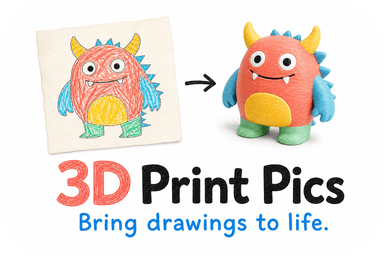
A custom 3D print made from a photo costs about $50 to $78 at 3D Print Pics, plus an optional $10 for rush processing. The plastic itself is only a few dollars of that. Most of the price pays for turning a flat image into a printable 3D model, previewing it and printing it. Below is what sits behind the price, where the cost climbs, and how to get the best result for your budget.
TL;DR
- At 3D Print Pics, custom 3D models from a photo, drawing or logo run $49.99 to $77.99 per model. Rush processing adds $10.
- Material is a small share of the cost. PLA filament typically runs about $20 to $30 per kilogram, which is roughly 2 to 3 cents per gram.
- The real cost is the work: turning a 2D image into a clean, printable 3D shape, then checking and printing it.
- Size, detail and the number of colors are what move the price up or down. A clear photo keeps you at the lower end of any range.
- You see a 3D preview before you commit, so you are not paying for a surprise.
Table of Contents
- What a photo 3D print actually costs
- Why the filament is the cheap part
- The real cost: turning a photo into a model
- What pushes the price up or down
- Example budgets
- How to keep the cost down without losing quality
- Perspective
- Who gets the most value from a photo print
- How this compares with other routes
- Order your photo print
- A short checklist before you order
- FAQ
- Sources
What a photo 3D print actually costs
Search for "3D printing cost" and you will find numbers that look nothing like each other. One page says a print costs pennies. Another quotes $50 or more. Both can be true, because they describe different things.
The pennies figure is the cost of running your own printer with a model you already have. The higher figure is what you pay when someone else builds the model from your photo, prints it and ships it. For a photo-based keepsake, the second situation is yours.
Here is how the pieces break down for a custom photo print.
| Cost component | What it covers | Typical size of the cost |
|---|---|---|
| Model creation | Turning your 2D photo, drawing or logo into a 3D shape | The largest share |
| Preview and approval | Seeing the 3D model before printing | Included in the model price |
| Material | PLA plastic in your chosen colors | A few dollars at most for a small piece |
| Print time | Machine time, power, wear | Small per piece |
| Finishing and packing | Clean-up, checking, boxing | Small but real |
| Delivery | Getting it to your door | Depends on the order and destination |
We publish a plain price range for our service: custom 3D models are $49.99 to $77.99, one-off. Rush processing is a separate $10 one-off fee. Where your order lands in that range depends mainly on the size and complexity of what you want made.
Why the filament is the cheap part
It helps to know how little plastic costs, because it explains why a $60 keepsake is not "overpriced plastic."
PLA, the plant-based plastic used for most desktop printing, typically sells for $20 to $30 per kilogram, or about $0.02 to $0.03 per gram. A figurine that weighs 50 grams therefore uses roughly $1 to $1.50 of material. Even with some waste from failed attempts or color changes, the plastic stays a small line item.
So when you compare a photo print to a "3D printing cost per gram" figure, you are comparing the wrong things. Per-gram figures describe a print where the model already exists and the machine is already owned. They leave out the part you actually need help with: getting from a photo to a model that prints well.
The real cost: turning a photo into a model
A photo is flat. It has no information about the back of a head, the underside of a paw or how thick a drawn line should be. Someone, or something, has to make those decisions.
That step is where most of the price lives. A model that is built carelessly can have thin walls, holes or floating pieces that fail on the printer. Fixing those problems takes time. If you want to see what that process involves, our guide to a photo to STL workflow that reduces failed prints walks through it.
There is also a choice between scanning a physical object and generating a model from a picture. Scanning needs the object in hand and often special equipment. A photo needs only the photo. We compare the two routes in photo vs 3D scan, which is useful if you are weighing a more expensive scanning service against simply uploading an image.

What pushes the price up or down
Five things matter most. Think of them as dials you can turn before you order.
Size
Larger pieces use more plastic and take longer to print. A desk-sized figure costs more than a pocket-sized one. If you are unsure what suits your use, the custom 3D print sizes guide explains how big, how small and what to pick for shelves, desks and gifts.
Detail and complexity
A simple logo or a bold child's drawing is easier to turn into a solid model than a photo with fine fur, thin whiskers or lace. Intricate shapes take more cleanup. Small details can also disappear when a piece is printed small, so a simpler subject often looks better as well as costing less.
Number of colors
More colors mean more material changes and more planning. We offer up to 7 color choices in non-toxic PLA. Choosing fewer colors for a bold, readable design is often the smarter move. A character drawn in three strong colors will usually read better on a shelf than one in seven pale shades.
Turnaround
Standard processing is included in the model price. If you need the piece sooner, rush processing is $10 extra. For a sense of how long the whole process takes from print to doorstep, see our breakdown of 3D printing turnaround time.
Quantity
One custom model is a one-off job. Ordering for a classroom, a team or a promotional run is a different conversation, because you may want several pieces from one design. If you are planning for a business, our mascot 3D print cost article covers what to budget.
Example budgets
These examples use only our published prices. Your final price depends on the size and complexity you choose.
A child's drawing for a grandparent. One model at the published range, $49.99 to $77.99. A bold drawing with a few strong colors is a good fit. If the gift is for a birthday that is close, add the $10 rush fee.
A pet keepsake. One model, same range. Use a sharp, well-lit photo taken at the pet's eye level, and the preview will show you whether the likeness is what you want before anything prints.
A logo for a small business desk. One model for the shop counter or reception. If you want matching pieces for several locations, plan for one model per piece and total it up before you order.
A classroom project. A teacher or PTA might choose one standout piece, such as a school mascot or a winning student drawing, rather than a print for each child. That keeps the budget manageable and makes the result feel special.
How to keep the cost down without losing quality
- Start with a clear photo. Good light, a plain background and a sharp subject save the most time and give the cleanest model.
- Pick a bold subject. Strong shapes print better than fine texture.
- Choose fewer colors. Three or four well-chosen colors often look better than a crowded palette.
- Use the preview. Check the 3D preview carefully. Approving the right version the first time avoids a second attempt.
- Plan the date. Order early so you do not need the $10 rush fee, unless the deadline is firm.
- Pick the right size. Do not pay for a large piece if it will live on a bookshelf.
If you already have a 3D file, you do not need to start from a photo. Our guide to ordering custom 3D prints with your own model explains how to skip reuploads.
Perspective
Many people look at a price like $49.99 and compare it with the few dollars of plastic in the piece. That comparison misses the point. What you are buying is the translation: a flat picture of something you love, rebuilt as an object you can hold.
We built our service around that translation. You upload an image, choose your colors, and see a 3D model preview before you finalize anything. That preview matters for cost, because it means you approve the shape first and pay for the print once you are happy with it.
We also think the materials should be easy to trust. Our prints use non-toxic PLA, which is why we are comfortable with families, classrooms and gift shoppers using the service for children's art and keepsakes.
Our advice on budget is simple. Start with the subject that matters most to you, keep the design bold, and pick the size that fits the place it will live. A single well-chosen piece is worth more than several rushed ones.
Ian
Who gets the most value from a photo print
The price makes the most sense when the piece carries meaning that a store-bought item cannot. These are the situations where our customers tend to get the most from it.
Parents who want to keep a child's drawing from disappearing into a folder. A drawing turned into a solid object can sit on a shelf for years. Our guide on one-photo paintable 3D prints covers photo prep, preview and PLA safety for this exact use.
Pet owners who want a keepsake to remember a companion. One clear photo is often enough to start.
Teachers, PTAs and homeschool families who want a standout classroom piece or a project model. For signs and classroom labels, see quick 3D signs from photos.
Small businesses who want a mascot or logo for a counter, a trade show table or a promotional gift.
Hobbyists who want a tabletop miniature based on their own character art.
If you are still deciding whether a figurine is the right format, our article on turning one photo into a no-scan 3D figurine shows what the preview step looks like.

How this compares with other routes
There are a few other ways to get a 3D object from a photo. They differ in what you pay and in what you do yourself.
| Route | What you do | Where the cost goes |
|---|---|---|
| Buy your own printer and learn modeling | Everything: model, slice, print, fix failures | Printer, filament, software, your time |
| Hire a freelance 3D artist plus a print shop | Brief the artist, then order the print separately | Two bills: modeling and printing |
| Scan a physical object | Bring the object to a scanner | Scanning plus cleanup and printing |
| Upload a photo to a photo-to-print service | Upload, pick colors, approve the preview | One price covering model, print and delivery |
The last route is the one we built. The all-in price is easy to plan around, and you do not need any 3D software or equipment. For a deeper look at what small buyers typically pay across these routes, read what small buyers pay for custom 3D prints.
Order your photo print
If your photo is ready, the simplest next step is to upload it and see the preview. You pick your colors and size, check the 3D model, and decide only when you like what you see. Custom models are $49.99 to $77.99, and rush processing is an extra $10 if you need it sooner.

Upload your photo and preview your 3D model at 3D Print Pics. If you run a blog, a school group or a business and want to recommend us, there is also an affiliate program that shares revenue on qualifying orders.
A short checklist before you order
- Photo: sharp, well lit, subject fills most of the frame, plain background if possible.
- Subject: one clear subject is easier than a crowd.
- Colors: pick the main colors first, then add accents only if they matter.
- Size: decide where the piece will sit before choosing.
- Deadline: if the date is firm, order early or add rush processing.
- Preview: look at all sides of the 3D model, not only the front.
FAQ
How much does a 3D photo cost?
At 3D Print Pics, a custom 3D model made from your photo, drawing or logo is $49.99 to $77.99. Rush processing is an extra $10. The price within the range depends on the size and complexity of the piece.
How much does 3D printing cost per gram?
For a desktop printer using PLA, the filament alone runs about 2 to 3 cents per gram. That figure covers only plastic. It does not include making a model from your photo, which is where most of a custom keepsake's price comes from.
Why does a small print cost more than the plastic in it?
Because you are paying for the model, not just the material. A photo is flat, so the 3D shape has to be built, checked for printability and previewed before printing. The plastic is a small part of the total.
Can I see the model before I pay for the print?
Yes. Our process shows a 3D model preview that you approve before the order is finalized. That lets you catch anything you would like changed before printing starts.
Is the material safe for children's gifts?
Our prints use non-toxic PLA. As with any small object, check that the size and shape suit the age of the child, and keep small parts away from very young children.