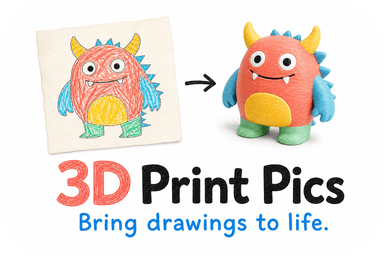
You can 3D print almost any board game piece: pawns, meeples, tokens, score markers, dice, card holders and trays. The two things that decide whether a piece works are its measurements and its material. If you want a one-of-a-kind pawn, such as your kid's drawing or your dog as a game piece, you can upload the image and we turn it into a 3D model you approve before anything prints.
This guide covers what to print, how to size it, how to choose a material, how to finish it, and what to check before you print someone else's design.
TL;DR
- Start small: a flat token or a single replacement pawn is easy to measure, test and fix before you commit to a full set.
- Measure the base, slot, peg, hole and height with calipers, print one test piece, then print the rest.
- Plain PLA suits tokens, pawns and organizers. Resin suits fine miniature detail but needs more cleanup and ventilation.
- Keep bases and heights consistent so custom pieces feel like a set, and design pieces that are easy to pick up.
- Check the file license, and keep in mind that a license does not cover third-party logos or characters.
Table of Contents
- What you can print for a board game
- Measure before you print
- Design pieces people want to handle
- Choosing a material: PLA, PETG or resin
- Finishing: sanding, priming and sealing
- Where to find files, and what the license says
- Organizers and card storage
- Perspective
- Turn a drawing or photo into a custom game piece
- Promo: your artwork as a game piece
- A short checklist before you print
- FAQ
- Sources
What you can print for a board game
The list is longer than most people expect. Pieces fall into three groups:
- Things players move: pawns, meeples, character standees, chess and checkers sets, modular tiles.
- Things players track: turn and resource tokens, score markers, dice, tile racks, player dashboards.
- Things that hold the game: card holders, trays, dice towers and box inserts.
For a first project, pick a flat piece. A replacement token or a small accessory has few dimensions to get wrong, and you can finish it quickly. Once that works, move on to taller pieces or a full organizer.
A custom piece is different from a replacement. A replacement must match something that already exists, so accuracy is the whole job. A custom piece is a chance to make the game yours, with a pawn shaped like a family member, a mascot for a club game or a classroom game with characters the students drew.

Measure before you print
Most failed board game prints fail on size, not on quality. Princeton University's EPICS program documented this in its Ludo board game project. The team printed replacement pawns, found the first pieces were too small for the board slots, then measured the wooden board and corrected the model dimensions.
You can avoid that detour with a short routine:
- Measure every contact point. That means the base diameter, slot width, peg, hole, stacking face and maximum height. Digital calipers beat a ruler for this.
- Leave clearance. Pieces that slide into slots or boxes need a small gap. Treat any figure you read online as a starting point, not a rule, because printers and filaments differ.
- Print one test piece. Check that it drops into the slot, stands on its own, stacks if it should, and can be seen across the table.
- Check the box. If you are printing pieces that must go back in the original box, close the lid with the test piece inside.
- Then print the set.
For organizers, the extra variables are the exact edition of the game, any expansions, and whether your cards are sleeved. Sleeves add thickness, and a tray cut for bare cards will not hold a sleeved deck.
Design pieces people want to handle
A piece can fit perfectly and still be annoying at the table. Guides on printing game pieces stress what they call handleability: pieces should be easy to pick up and move, stack when needed, and feel substantial rather than cheap. A slight lip makes flat tokens much easier to lift off a table.
A few habits make a set look and feel deliberate:
- Keep base sizes consistent across all pieces in a set.
- Use cohesive heights, so no pawn towers over the rest unless the game calls for it.
- Give each player a clear color or shape cue, so pieces are readable from across the board.
- Design flat-bottomed pieces that print without supports, which avoids support marks on the finished piece.
The SCOPES-DF classroom lesson on customized board game pieces frames this as a design loop. Define who will use the piece and what constraints it has, build a prototype, then test it against those needs instead of treating the first digital design as finished. It uses Tinkercad to resize, add shapes and rotate a game piece, which is a friendly starting point if you want to model something yourself.
Choosing a material: PLA, PETG or resin
The right material depends on what the piece does. Pieces handled by many hands or tossed in a bag need toughness. Display pieces need fine detail.
As a general guide from gaming-focused printing coverage:
| Material | Good for | Things to know |
|---|---|---|
| PLA (filament) | Tokens, pawns, trays, inserts, terrain | Low warp, easy to paint |
| PETG (filament) | Pieces that need extra toughness | Tougher than PLA |
| ABS (filament) | Durable parts | Needs an enclosed printer |
| Resin | High-detail miniatures, fine bases | More post-processing and ventilation |
The same source suggests layers of roughly 0.08 to 0.12 mm for filament-printed minis, and 15 to 30% infill with thicker shells for board inserts. Treat those as sensible starting points, then test any fit that matters before printing a full set.
For most families, teachers and gift buyers, PLA is the practical answer: pawns and tokens are chunky, they get handled a lot, and the material takes paint well. If you are weighing the two options for a specific project, our comparison of PLA vs resin walks through which fits which job.
Finishing: sanding, priming and sealing
A raw print is playable. A finished one looks like it belongs in the box. The usual sequence for filament prints, as described by the same gaming guide, is:
- Remove any supports and nubs.
- Sand layer lines with progressively finer grits, such as 220, then 400, then 800.
- Prime the piece.
- Paint with thin coats of acrylic.
- Seal with a matte varnish so paint survives repeated handling.
Resin prints add a wash and cure step before any of this. If you have kids helping, the sanding and painting stages are the fun ones: a plain pawn becomes a project. Our guide to paintable 3D prints covers photo prep, preview and PLA safety in more detail.
Where to find files, and what the license says
If you do not want to model anything, you can start from a ready-made file. Two points matter when you download one.
File format. 3MF files keep their units and mesh intact and open directly in slicers such as Bambu Studio, PrusaSlicer, OrcaSlicer and Cura, according to a library of printable games and figures. STL is the other common format and works almost everywhere.
License. Read it every time. Some Creative Commons files do not allow commercial use, which matters if you plan to sell a set or use pieces in a paid event. A file license also does not grant rights to third-party logos, characters, artwork or trademarks that appear in the design. A pawn that looks like a famous character is a separate question from whether the file is free to download. For the details, see our guides on fan art legality in the US and what is protected in a printed logo.

Personal use of your own drawings, photos and characters avoids most of these questions, which is one reason custom pieces from your own artwork are such a clean option.
Organizers and card storage
Not every board game piece moves across the board. Trays, card holders and box inserts keep a game playable, and they are often the first thing people print after buying a printer. They also have the strictest fit requirements, because they must match the exact game box.
The measuring routine above applies directly: edition, expansions, sleeves, box height. If you are planning how decks and components will live together, these card deck storage ideas cover setups that work for game night and for classroom displays alike.
Perspective
Most board game pieces are generic by design. A game ships with the same plastic pawn for every family, and nobody remembers it.
What people keep are the pieces that mean something: the pawn that looks like the dog, the token that is a child's drawing of a dragon, the mascot that a club or classroom picked together. That is the part we care about.
Our approach is built for people who are not modelers. You upload a picture, choose your colors, and see a 3D model preview before you commit. We print in non-toxic PLA, with up to 7 color choices and size options, so a piece can be scaled to suit a table, a shelf or a classroom.
Our advice for board games: use your own artwork as the starting point, measure the slot or base the piece has to fit, and tell us the size you need. A drawing from a seven-year-old makes a better game piece than anything in a stock library, because it was made by someone at the table.
Ian
Turn a drawing or photo into a custom game piece
If you want a one-off piece rather than a printed set from a file library, we can build it from your image. Our process is designed to be simple:
- Upload a picture, drawing or logo.
- Choose colors (up to 7 are available) and size.
- Review the AI-generated 3D model preview.
- Approve it, and we print it in non-toxic PLA and ship it to your door.
Custom 3D models are priced from $49.99 to $77.99 as published on our site, and rush processing is an extra $10. That fits a single hero piece well, such as a family pawn, a team mascot or a trophy token for a winner. For a full set of identical tokens, a file you print yourself is usually the more practical route. For pricing context across small custom orders, see our breakdown of what small buyers pay for custom 3D prints.
Businesses and clubs can use the same process for a branded game piece, and our guide to mascot 3D printing shows how a logo or drawing becomes a figurine.
Promo: your artwork as a game piece
Have a drawing, a pet photo or a logo that deserves a place on the board? Upload it, pick your colors and size, and preview the 3D model before you order. We print in non-toxic PLA and deliver to your door.

Start your custom 3D model and see the preview before you decide. Models run $49.99 to $77.99, and rush processing is $10 extra if game night is close.
A short checklist before you print
- Do you know the exact measurements of the slot, base or box?
- Is the first piece a small, flat test?
- Is the material matched to how the piece will be handled?
- Are bases and heights consistent across the set?
- Does the file license allow your use, and is any logo or character cleared?
- Is the piece safe for the people using it? Pieces for young children should be large enough not to be a swallowing hazard, so supervise play with very young kids. Also note that PLA prints are not food-safe, as our guide on food safety for 3D prints explains, so keep game pieces out of mouths and snack bowls.
FAQ
What is the easiest board game piece to 3D print first?
A flat token or a single replacement pawn. These have few dimensions to get wrong, so you can measure, print a test and adjust quickly. Once that fits, move on to taller pieces or organizers.
Is PLA good enough for board game pieces?
For tokens, pawns, trays and inserts, yes. PLA is low-warp and takes paint well, and it is the material we use for our custom models. Resin is the usual choice only when you need very fine miniature detail.
Can I turn my child's drawing into a game piece?
Yes. Upload the drawing, choose colors and size, and review the 3D model preview before approving the order. Tell us the size you need so the piece suits the board or table it will be used on.
Can I print pieces from a game I own?
For personal use you generally need a file whose license allows it, and a license does not cover third-party logos, characters or artwork in the design. If you plan to sell or use pieces commercially, read the license closely first.
Sources
- Ludo Board Game, Princeton EPICS
- Customized Board Game Pieces, SCOPES-DF
- 3D Printing for Gamers: Create Custom Game Pieces
- 3D Printing Basic Game Pieces for Board Games
- Games and figures to 3D print